Showing posts with label The Eat-a-Bug Cookbook. Show all posts

Thursday, November 5, 2015

EATING "EVERYTHING IN MODERATION" IS PROBABLY JUST MAKING YOU FATTER


A new study of more than 6,000 people suggests this old diet rule isn't as healthy as once thought.

You’ve probably heard the rule that it’s okay to eat pretty much anything—even the bad stuff—as long as you eat it “in moderation.” Chicken breasts and spinach? In moderation. Bacon cheeseburgers and pound cake? Same theory applies.

But new research suggests that a more varied diet also tends to be a more unhealthy diet—at least when it comes to your waist size, according to new research from University of Texas Health Science Center at Houston and the Friedman School of Nutrition Science and Policy at Tufts University.

In the study, which was published in the journal PLOS ONE, researchers looked at data from 6,814 participants in the Multi-Ethnic Study of Atherosclerosis to determine the "diversity" of the participants' diets—measured by factors like how many different foods they ate in a week, how many calories were consumed in the average food item, and the range of healthy foods versus unhealthy foods.

The researchers then looked at how those diets affected participants’ waistlines after five years. (“Waist circumference is an important indicator of central fat and metabolic health,” the study notes, in case you’ve somehow missed all those diet-plan commercials featuring retired NFL commentators.)

The results: After five years, participants who ate the widest variety of food had gotten the widest, gaining 120% more in waist size than study participants who had much less varied diets.

"An unexpected finding was that participants with greater diversity in their diets… actually had worse diet quality," wrote lead study author Marcia C. de Oliveira Otto, Ph.D., of UTHealth. "They were eating less healthy foods, such as fruits and vegetables, and more unhealthy foods, such as processed meats, desserts and soda."

So while the participants may have been eating everything in moderation, they still ate everything—including unhealthy junk.

"Americans with the healthiest diets actually eat a relatively small range of healthy foods," said Dariush Mozaffarian, M.D., Dr.P.H., a senior study author and the dean of the Friedman School.

What to eat, then? You could start with our list of the 20 fittest foods you can pile on your plate, while making sure to avoid the eight absolute worst foods you can pump into your body. Steer clear of these 20 foods that seem healthy but aren't, burn more fat with these tasty everyday fruits, and make sure you make room for these 10 superfoods people have totally forgotten about.

Source by: http://www.mensfitness.com/weight-loss/burn-fat-fast/eating-everything-moderation-probably-just-making-you-fatter

Thursday, October 29, 2015

Are We Sexist About Healthy Food?


Women are making strides at breaking through gender stereotypes: We’re tackling higher positions in the professional world; taking on roles traditional reserved for men, like coaching and refereeing; and we even have the president declaring that playing like a girl means being a badass. (Check out These Strong Women Who Are Changing the Face of Girl Power As We Know It.)

One area where gender stereotypes still hold strong though? The world of nutrition. Researchers from Yale and the University of Manitoba in Canada have found that not only do we associate certain foods with being feminine or masculine, but also the gender we associate them with actually affects how delicious we think the bite is.

In a study in Social Psychology, researchers had participants separate foods like potatoes, chicken, and fish into “masculine” and “feminine” categories and, not surprisingly, both sexes were more likely to mark healthy foods—yogurt, salad—as feminine and unhealthier foods—fried chicken, potato chips—as more masculine. While it’s great that women can order a salad without someone thinking twice, it’s not going to help America’s obesity epidemic at all if we (even unconsciously) mock our men for trying to clean up their diet.

What’s crazy, though, is that sexism even played a role in how happy people’s tastebuds were. In another experiment, the same researchers had guys and gals taste test the exact same blueberry muffin. When it was labeled as a “Mega Muffin” (intended to convey unhealthiness) in a masculine packaging (men playing football), both sexes rated the muffin as tastier and worth spending more of their hard earned cash on compared to when the label had a female ballet dancer on it. (How else are you tricking yourself? Learn how Reusable Grocery Bags May Be Wrecking Your Diet.)

In other words, our indulgences actually taste better when we feel like they’re a macho choice, and most people think food is healthier and delicious simply because of girly packaging. (Don’t be fooled by pink packaging! Here’s 50 Seemingly Healthy Foods that are Bad for You.)

Interestingly, the sustenance sexism only appeals until we’re conscious of it. When the gendered packaging was taken too far—in this case, labeled as “the muffin for real men” with the same football imagery—people were willing to pay less for it than the Mega Muffin.

Source by:http://www.shape.com/healthy-eating/diet-tips/are-we-sexist-about-healthy-food

Wednesday, October 21, 2015

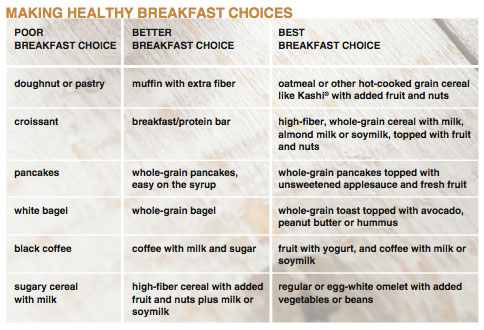
Eating a Better Breakfast


The alarm rings and you press “snooze” one time too many. By the time you roll out of bed, you think it’s too late for breakfast so you don’t eat. While some people do skip breakfast on a regular basis, it’s not a good idea. The potential perils include a more sluggish metabolism as the body shifts into starvation-response mode. Couple this with a tendency to become ravenous and binge later, and weight gain can happen. Cognitive abilities can also suffer: You may get headaches, feel fatigued and be less able to concentrate.

Learn how a lack of breakfast can impact exercise and what kinds of foods will give you the energy you need for the day from Martica Heaner, PhD, MA, MEd, NASM-certified trainer, award-winning group fitness instructor, and adjunct assistant professor of nutrition at Hunter College in New York City.

Exercise and Skipping Breakfast

Some people believe that by exercising on an empty stomach in the morning, they’ll burn more body fat. However, if the body burns a higher percentage of fat while exercising on no breakfast in the morning (and study results are mixed), that doesn’t mean metabolism—or total calorie burn—is speeding up. “If you’re going to do a long or strenuous workout on an empty stomach, you may not have adequate carbs to power your workout and so you won’t be able to work out as long or as hard,” says Enette Larson-Meyer, PhD, RD, FACSM, nutrition professor at the University of Wyoming and author of Vegetarian Sports Nutrition (Human Kinetics 2007). “Even if you are burning a slightly higher ratio of fat, with impaired performance you may not be burning as many total calories or total calories of fat as you could if you were well-fueled.”

What Counts as Breakfast?

“Usually we aim for breakfast providing 25%–30% of the calories for the day, so the amount will depend on a person’s daily energy expenditure,” says Larson-Meyer. Ideally, the morning meal should provide carbohydrates and fiber from fruits, vegetables and/or beans, as well as protein from dairy or, better, from plant-based varieties of milk or yogurt, as well as eggs or plant foods like beans and whole grains. While fruit is generally recommended over juice because fruit contains more fiber and fewer calories, a lean exerciser need not fear juice. “Most people should avoid drinking their calo- ries, but if juice is an easy energy source before your workout in the morning, go ahead and drink it,” Larson-Meyer says.

What about doughnuts or pastries? “Something is better than nothing, and if you’re in the woods starving, a doughnut is okay,” says Melinda Manore, PhD, RD, nutrition professor at Oregon State University, Corvallis, and author of several textbooks, including Nutrition for Life (Benjamin Cummings 2006). But keeping a stash of easy breakfast backups, like breakfast bars, nuts or even cold leftovers, can give you more nutritious choices so that you’re not just filling up on empty calories. Don’t be afraid to get creative: Some cultures eat soups for breakfast, others eat beans (on toast or in bean burritos). Aim for a breakfast that provides energy and nutrients and that helps you feel satiated.

Source by:http://www.ideafit.com/fitness-library/eating-a-better-breakfast

Saturday, October 17, 2015

[eating bugs] Insects Are More Nutritious Than Animal Sources of Protein


Get out your shovel: Crickets and caterpillars, gram for gram, beat chicken and steak as the best sources of protein and nutrients

By  Macaela MacKenzie

We're all about getting the biggest nutritional bang per bite (we see you superfoods!), so much so that we'll consider digging up some protein—in our backyard. According to a new study in the European Journal of Clinical Nutrition caterpillars, crickets, meal worms, bees, and other bugs are more nutritious, gram for gram, than steak or chicken.

Researchers at Oxford University tested six commercially available types of insects (albeit not your usual grocery store fare) and found that across all six options, a 100 grams of bugs (roughly 200 crickets) is actually packed with more protein, energy, calcium and vitamins than a 100 gram serving of chicken, steak, or other meat (about the size of your computer mouse). Yummy. (Eating weird food that delivers a ton of nutrients shouldn't be as unimaginable as eating normal ingredients that are actually robbing you of nutrients, like these seven.)

Before you cue the gag reflex, entomophagy (the scientific term for eating bugs) is actually incredibly environmentally friendly. While the production of cattle or poultry takes a lot of time, money, and ecological investment (livestock need 1.3 billion tons of grain every year in order to fatten up for the farmers market shelves—yikes!), insects take just days to mature and are pretty cheap to maintain. (Also try these Eco-Friendly Fish Recipes for Sardines, Herring, and Other Small Fish.)

And it may not be as weird as you think. Cooking creepy crawlies is considered normal, sometimes even a delicacy, in countries around the world, like ants in Brazil, chocolate-covered locusts in Mexico, and deep-fried crickets in Thailand. In the U.S., cricket flour has been on the market for quite some time and there are even there are entire cookbooks devoted to baking bugs, like The Eat-a-Bug Cookbook, Revised: 40 Ways to Cook Crickets, Grasshoppers, Ants, Water Bugs, Spiders, Centipedes, and Their Kin that includes recipes like White Chocolate and Wax Worm Cookies and Deep Fried Tarantulas.

Source by: http://www.shape.com/healthy-eating/diet-tips/eating-bugs-insects-are-more-nutritious-animal-sources-protein